The hotplug code still triggers the warning about using a stale
rq->clock value.

Fix things up to actually run update_rq_clock() in a place where we
record the 'UPDATED' flag, and then modify the annotation to retain
this flag over the rq->lock fiddling that happens as a result of
actually migrating all the tasks elsewhere.

Reported-by: Linus Torvalds <[email protected]>
Tested-by: Mike Galbraith <[email protected]>
Tested-by: Sachin Sant <[email protected]>
Tested-by: Borislav Petkov <[email protected]>
Signed-off-by: Peter Zijlstra (Intel) <[email protected]>
Reviewed-by: Matt Fleming <[email protected]>
Cc: Michael Ellerman <[email protected]>
Cc: Peter Zijlstra <[email protected]>
Cc: Ross Zwisler <[email protected]>
Cc: Thomas Gleixner <[email protected]>
Fixes: 4d25b35ea3 ("sched/fair: Restore previous rq_flags when migrating tasks in hotplug")
Link: http://lkml.kernel.org/r/[email protected]
Signed-off-by: Ingo Molnar <[email protected]>
Since commit:

  321027c1fe ("perf/core: Fix concurrent sys_perf_event_open() vs. 'move_group' race")

... the code looks like (assuming move_group==1):

  gctx = __perf_event_ctx_lock_double(group_leader, ctx);

  perf_remove_from_context(group_leader, 0);
  list_for_each_entry(sibling, &group_leader->sibling_list, group_entry) {
	perf_remove_from_context(sibling, 0);
	put_ctx(gctx);
  }

  /* ... */

  /* misleading comment about how this is the last reference */
  put_ctx(gctx);

  perf_event_ctx_unlock(group_leader, gctx);

What that 'last' put_ctx() does is drop @group_leader's reference on
gctx after having dropped all its potential sibling references.

But the thing is that __perf_event_ctx_lock_double() returns with a
reference _and_ a held lock, and perf_event_ctx_unlock() unlocks that
lock and drops that reference. Therefore that put_ctx() cannot be the
'last' of anything, nor is there an unbalance in puts.

To reduce confusion, remove the comment and place the put_ctx() next
to the remove_from_context() call.

Reported-by: Ben Hutchings <[email protected]>
Signed-off-by: Peter Zijlstra (Intel) <[email protected]>
Cc: Alexander Shishkin <[email protected]>
Cc: Arnaldo Carvalho de Melo <[email protected]>
Cc: Jiri Olsa <[email protected]>
Cc: Linus Torvalds <[email protected]>
Cc: Peter Zijlstra <[email protected]>
Cc: Stephane Eranian <[email protected]>
Cc: Thomas Gleixner <[email protected]>
Cc: Vince Weaver <[email protected]>
Signed-off-by: Ingo Molnar <[email protected]>
While looking through the __ex_table stuff I found that we do a linear
lookup of the module. Also fix up a comment.

Signed-off-by: Peter Zijlstra (Intel) <[email protected]>
Acked-by: Mark Rutland <[email protected]>
Signed-off-by: Jessica Yu <[email protected]>
Provide refcount_t, an atomic_t like primitive built just for
refcounting.

It provides saturation semantics such that overflow becomes impossible
and thereby 'spurious' use-after-free is avoided.

Signed-off-by: Peter Zijlstra (Intel) <[email protected]>
Cc: Linus Torvalds <[email protected]>
Cc: Peter Zijlstra <[email protected]>
Cc: Thomas Gleixner <[email protected]>
Signed-off-by: Ingo Molnar <[email protected]>
Steve noticed that when we switch from IDLE to SCHED_OTHER we fail to
take the shortcut, even though all runnable tasks are of the fair
class, because prev->sched_class != &fair_sched_class.

Since I reworked the put_prev_task() stuff, we don't really care about
prev->class here, so removing that condition will allow this case.

This increases the likely case from 78% to 98% correct for Steve's
workload.

Reported-by: Steven Rostedt (VMware) <[email protected]>
Tested-by: Steven Rostedt (VMware) <[email protected]>
Signed-off-by: Peter Zijlstra (Intel) <[email protected]>
Cc: Andrew Morton <[email protected]>
Cc: Linus Torvalds <[email protected]>
Cc: Mike Galbraith <[email protected]>
Cc: Peter Zijlstra <[email protected]>
Cc: Thomas Gleixner <[email protected]>
Link: http://lkml.kernel.org/r/[email protected]
Signed-off-by: Ingo Molnar <[email protected]>
In commit:

  659cf9f582 ("locking/ww_mutex: Optimize ww-mutexes by waking at most one waiter for backoff when acquiring the lock")

I replaced a comment with a lockdep_assert_held(). However it turns out
we hide that lock from lockdep for hysterical raisins, which results
in the assertion always firing.

Remove the old debug code as lockdep will easily spot the abuse it was
meant to catch, which will make the lock visible to lockdep and make
the assertion work as intended.

Reported-by: Mike Galbraith <[email protected]>
Signed-off-by: Peter Zijlstra (Intel) <[email protected]>
Cc: Linus Torvalds <[email protected]>
Cc: Nicolai Haehnle <[email protected]>
Cc: Peter Zijlstra <[email protected]>
Cc: Thomas Gleixner <[email protected]>
Fixes: 659cf9f582 ("locking/ww_mutex: Optimize ww-mutexes by waking at most one waiter for backoff when acquiring the lock")
Link: http://lkml.kernel.org/r/20170117150609.GB32474@worktop
Signed-off-by: Ingo Molnar <[email protected]>
Dmitry reported a KASAN use-after-free on event->group_leader.

It turns out there's a hole in perf_remove_from_context() due to
event_function_call() not calling its function when the task
associated with the event is already dead.

In this case the event will have been detached from the task, but the
grouping will have been retained, such that group operations might
still work properly while there are live child events etc.

This does however mean that we can miss a perf_group_detach() call
when the group decomposes, this in turn can then lead to
use-after-free.

Fix it by explicitly doing the group detach if its still required.

Reported-by: Dmitry Vyukov <[email protected]>
Tested-by: Dmitry Vyukov <[email protected]>
Signed-off-by: Peter Zijlstra (Intel) <[email protected]>
Cc: Alexander Shishkin <[email protected]>
Cc: Arnaldo Carvalho de Melo <[email protected]>
Cc: Arnaldo Carvalho de Melo <[email protected]>
Cc: Jiri Olsa <[email protected]>
Cc: Linus Torvalds <[email protected]>
Cc: Mathieu Desnoyers <[email protected]>
Cc: Peter Zijlstra <[email protected]>
Cc: Thomas Gleixner <[email protected]>
Cc: [email protected] # v4.5+
Cc: syzkaller <[email protected]>
Fixes: 63b6da39bb ("perf: Fix perf_event_exit_task() race")
Link: http://lkml.kernel.org/r/[email protected]
Signed-off-by: Ingo Molnar <[email protected]>
Mike reported that he could trigger the WARN_ON_ONCE() in
set_sched_clock_stable() using hotplug.

This exposed a fundamental problem with the interface, we should never
mark the TSC stable if we ever find it to be unstable. Therefore
set_sched_clock_stable() is a broken interface.

The reason it existed is that not having it is a pain, it means all
relevant architecture code needs to call clear_sched_clock_stable()
where appropriate.

Of the three architectures that select HAVE_UNSTABLE_SCHED_CLOCK ia64
and parisc are trivial in that they never called
set_sched_clock_stable(), so add an unconditional call to
clear_sched_clock_stable() to them.

For x86 the story is a lot more involved, and what this patch tries to
do is ensure we preserve the status quo. So even is Cyrix or Transmeta
have usable TSC they never called set_sched_clock_stable() so they now
get an explicit mark unstable.

Reported-by: Mike Galbraith <[email protected]>
Signed-off-by: Peter Zijlstra (Intel) <[email protected]>
Cc: Borislav Petkov <[email protected]>
Cc: Linus Torvalds <[email protected]>
Cc: Peter Zijlstra <[email protected]>
Cc: Thomas Gleixner <[email protected]>
Fixes: 9881b024b7 ("sched/clock: Delay switching sched_clock to stable")
Link: http://lkml.kernel.org/r/[email protected]
Signed-off-by: Ingo Molnar <[email protected]>
Documentation/scheduler/completion.txt says this about complete_all():

  "calls complete_all() to signal all current and future waiters."

Which doesn't strictly match the current semantics. Currently
complete_all() is equivalent to UINT_MAX/2 complete() invocations,
which is distinctly less than 'all current and future waiters'
(enumerable vs innumerable), although it has worked in practice.

However, Dmitry had a weird case where it might matter, so change
completions to use saturation semantics for complete()/complete_all().
Once done hits UINT_MAX (and complete_all() sets it there) it will
never again be decremented.

Requested-by: Dmitry Torokhov <[email protected]>
Signed-off-by: Peter Zijlstra (Intel) <[email protected]>
Cc: Linus Torvalds <[email protected]>
Cc: Mike Galbraith <[email protected]>
Cc: Peter Zijlstra <[email protected]>
Cc: Thomas Gleixner <[email protected]>
Cc: [email protected]
Cc: [email protected]
Signed-off-by: Ingo Molnar <[email protected]>
When switching between the unstable and stable variants it is
currently possible that clock discontinuities occur.

And while these will mostly be 'small', attempt to do better.

As observed on my IVB-EP, the sched_clock() is ~1.5s ahead of the
ktime_get_ns() based timeline at the point of switchover
(sched_clock_init_late()) after SMP bringup.

Equally, when the TSC is later found to be unstable -- typically
because SMM tries to hide its SMI latencies by mucking with the TSC --
we want to avoid large jumps.

Since the clocksource watchdog reports the issue after the fact we
cannot exactly fix up time, but since SMI latencies are typically
small (~10ns range), the discontinuity is mainly due to drift between
sched_clock() and ktime_get_ns() (which on my desktop is ~79s over
24days).

I dislike this patch because it adds overhead to the good case in
favour of dealing with badness. But given the widespread failure of
TSC stability this is worth it.

Note that in case the TSC makes drastic jumps after SMP bringup we're
still hosed. There's just not much we can do in that case without
stupid overhead.

If we were to somehow expose tsc_clocksource_reliable (which is hard
because this code is also used on ia64 and parisc) we could avoid some
of the newly introduced overhead.

Signed-off-by: Peter Zijlstra (Intel) <[email protected]>
Cc: Linus Torvalds <[email protected]>
Cc: Mike Galbraith <[email protected]>
Cc: Peter Zijlstra <[email protected]>
Cc: Thomas Gleixner <[email protected]>
Cc: [email protected]
Signed-off-by: Ingo Molnar <[email protected]>
Currently we switch to the stable sched_clock if we guess the TSC is
usable, and then switch back to the unstable path if it turns out TSC
isn't stable during SMP bringup after all.

Delay switching to the stable path until after SMP bringup is
complete. This way we'll avoid switching during the time we detect the
worst of the TSC offences.

Signed-off-by: Peter Zijlstra (Intel) <[email protected]>
Cc: Linus Torvalds <[email protected]>
Cc: Mike Galbraith <[email protected]>
Cc: Peter Zijlstra <[email protected]>
Cc: Thomas Gleixner <[email protected]>
Cc: [email protected]
Signed-off-by: Ingo Molnar <[email protected]>
Add the update_rq_clock() call at the top of the callstack instead of
at the bottom where we find it missing, this to aid later effort to
minimize the number of update_rq_lock() calls.

  WARNING: CPU: 30 PID: 194 at ../kernel/sched/sched.h:797 assert_clock_updated()
  rq->clock_update_flags < RQCF_ACT_SKIP

  Call Trace:
    dump_stack()
    __warn()
    warn_slowpath_fmt()
    assert_clock_updated.isra.63.part.64()
    can_migrate_task()
    load_balance()
    pick_next_task_fair()
    __schedule()
    schedule()
    worker_thread()
    kthread()

Signed-off-by: Peter Zijlstra (Intel) <[email protected]>
Cc: Linus Torvalds <[email protected]>
Cc: Mike Galbraith <[email protected]>
Cc: Peter Zijlstra <[email protected]>
Cc: Thomas Gleixner <[email protected]>
Cc: [email protected]
Signed-off-by: Ingo Molnar <[email protected]>
Instead of adding the update_rq_clock() all the way at the bottom of
the callstack, add one at the top, this to aid later effort to
minimize update_rq_lock() calls.

  WARNING: CPU: 0 PID: 1 at ../kernel/sched/sched.h:797 detach_task_cfs_rq()
  rq->clock_update_flags < RQCF_ACT_SKIP

  Call Trace:
    dump_stack()
    __warn()
    warn_slowpath_fmt()
    detach_task_cfs_rq()
    switched_from_fair()
    __sched_setscheduler()
    _sched_setscheduler()
    sched_set_stop_task()
    cpu_stop_create()
    __smpboot_create_thread.part.2()
    smpboot_register_percpu_thread_cpumask()
    cpu_stop_init()
    do_one_initcall()
    ? print_cpu_info()
    kernel_init_freeable()
    ? rest_init()
    kernel_init()
    ret_from_fork()

Signed-off-by: Peter Zijlstra (Intel) <[email protected]>
Cc: Linus Torvalds <[email protected]>
Cc: Mike Galbraith <[email protected]>
Cc: Peter Zijlstra <[email protected]>
Cc: Thomas Gleixner <[email protected]>
Cc: [email protected]
Signed-off-by: Ingo Molnar <[email protected]>
Instead of inlining __mutex_lock_common() 5 times, once for each
{state,ww} variant. Reduce this to two, ww and !ww.

Then add __always_inline to mutex_optimistic_spin(), so that that will
get inlined all 4 remaining times, for all {waiter,ww} variants.

   text    data     bss     dec     hex filename

   6301       0       0    6301    189d defconfig-build/kernel/locking/mutex.o
   4053       0       0    4053     fd5 defconfig-build/kernel/locking/mutex.o
   4257       0       0    4257    10a1 defconfig-build/kernel/locking/mutex.o

This reduces total text size and better separates the ww and !ww mutex
code generation.

Signed-off-by: Peter Zijlstra (Intel) <[email protected]>
Cc: Andrew Morton <[email protected]>
Cc: Linus Torvalds <[email protected]>
Cc: Paul E. McKenney <[email protected]>
Cc: Peter Zijlstra <[email protected]>
Cc: Thomas Gleixner <[email protected]>
Cc: [email protected]
Signed-off-by: Ingo Molnar <[email protected]>
While reviewing the ww_mutex patches, I noticed that it was still
possible to (incorrectly) succeed for (incorrect) code like:

	mutex_lock(&a);
	mutex_lock(&a);

This was possible if the second mutex_lock() would block (as expected)
but then receive a spurious wakeup. At that point it would find itself
at the front of the queue, request a handoff and instantly claim
ownership and continue, since owner would point to itself.

Avoid this scenario and simplify the code by introducing a third low
bit to signal handoff pickup. So once we request handoff, unlock
clears the handoff bit and sets the pickup bit along with the new
owner.

This also removes the need for the .handoff argument to
__mutex_trylock(), since that becomes superfluous with PICKUP.

In order to guarantee enough low bits, ensure task_struct alignment is
at least L1_CACHE_BYTES (which seems a good ideal regardless).

Signed-off-by: Peter Zijlstra (Intel) <[email protected]>
Cc: Andrew Morton <[email protected]>
Cc: Linus Torvalds <[email protected]>
Cc: Paul E. McKenney <[email protected]>
Cc: Peter Zijlstra <[email protected]>
Cc: Thomas Gleixner <[email protected]>
Fixes: 9d659ae14b ("locking/mutex: Add lock handoff to avoid starvation")
Signed-off-by: Ingo Molnar <[email protected]>
Di Shen reported a race between two concurrent sys_perf_event_open()
calls where both try and move the same pre-existing software group
into a hardware context.

The problem is exactly that described in commit:

  f63a8daa58 ("perf: Fix event->ctx locking")

... where, while we wait for a ctx->mutex acquisition, the event->ctx
relation can have changed under us.

That very same commit failed to recognise sys_perf_event_context() as an
external access vector to the events and thereby didn't apply the
established locking rules correctly.

So while one sys_perf_event_open() call is stuck waiting on
mutex_lock_double(), the other (which owns said locks) moves the group
about. So by the time the former sys_perf_event_open() acquires the
locks, the context we've acquired is stale (and possibly dead).

Apply the established locking rules as per perf_event_ctx_lock_nested()
to the mutex_lock_double() for the 'move_group' case. This obviously means
we need to validate state after we acquire the locks.

Reported-by: Di Shen (Keen Lab)
Tested-by: John Dias <[email protected]>
Signed-off-by: Peter Zijlstra (Intel) <[email protected]>
Cc: Alexander Shishkin <[email protected]>
Cc: Arnaldo Carvalho de Melo <[email protected]>
Cc: Arnaldo Carvalho de Melo <[email protected]>
Cc: Jiri Olsa <[email protected]>
Cc: Kees Cook <[email protected]>
Cc: Linus Torvalds <[email protected]>
Cc: Min Chong <[email protected]>
Cc: Peter Zijlstra <[email protected]>
Cc: Stephane Eranian <[email protected]>
Cc: Thomas Gleixner <[email protected]>
Cc: Vince Weaver <[email protected]>
Fixes: f63a8daa58 ("perf: Fix event->ctx locking")
Link: http://lkml.kernel.org/r/[email protected]
Signed-off-by: Ingo Molnar <[email protected]>
There is problem with installing an event in a task that is 'stuck' on
an offline CPU.

Blocked tasks are not dis-assosciated from offlined CPUs, after all, a
blocked task doesn't run and doesn't require a CPU etc.. Only on
wakeup do we ammend the situation and place the task on a available
CPU.

If we hit such a task with perf_install_in_context() we'll loop until
either that task wakes up or the CPU comes back online, if the task
waking depends on the event being installed, we're stuck.

While looking into this issue, I also spotted another problem, if we
hit a task with perf_install_in_context() that is in the middle of
being migrated, that is we observe the old CPU before sending the IPI,
but run the IPI (on the old CPU) while the task is already running on
the new CPU, things also go sideways.

Rework things to rely on task_curr() -- outside of rq->lock -- which
is rather tricky. Imagine the following scenario where we're trying to
install the first event into our task 't':

CPU0            CPU1            CPU2

                (current == t)

t->perf_event_ctxp[] = ctx;
smp_mb();
cpu = task_cpu(t);

                switch(t, n);
                                migrate(t, 2);
                                switch(p, t);

                                ctx = t->perf_event_ctxp[]; // must not be NULL

smp_function_call(cpu, ..);

                generic_exec_single()
                  func();
                    spin_lock(ctx->lock);
                    if (task_curr(t)) // false

                    add_event_to_ctx();
                    spin_unlock(ctx->lock);

                                perf_event_context_sched_in();
                                  spin_lock(ctx->lock);
                                  // sees event

So its CPU0's store of t->perf_event_ctxp[] that must not go 'missing'.
Because if CPU2's load of that variable were to observe NULL, it would
not try to schedule the ctx and we'd have a task running without its
counter, which would be 'bad'.

As long as we observe !NULL, we'll acquire ctx->lock. If we acquire it
first and not see the event yet, then CPU0 must observe task_curr()
and retry. If the install happens first, then we must see the event on
sched-in and all is well.

I think we can translate the first part (until the 'must not be NULL')
of the scenario to a litmus test like:

  C C-peterz

  {
  }

  P0(int *x, int *y)
  {
          int r1;

          WRITE_ONCE(*x, 1);
          smp_mb();
          r1 = READ_ONCE(*y);
  }

  P1(int *y, int *z)
  {
          WRITE_ONCE(*y, 1);
          smp_store_release(z, 1);
  }

  P2(int *x, int *z)
  {
          int r1;
          int r2;

          r1 = smp_load_acquire(z);
	  smp_mb();
          r2 = READ_ONCE(*x);
  }

  exists
  (0:r1=0 /\ 2:r1=1 /\ 2:r2=0)

Where:
  x is perf_event_ctxp[],
  y is our tasks's CPU, and
  z is our task being placed on the rq of CPU2.

The P0 smp_mb() is the one added by this patch, ordering the store to
perf_event_ctxp[] from find_get_context() and the load of task_cpu()
in task_function_call().

The smp_store_release/smp_load_acquire model the RCpc locking of the
rq->lock and the smp_mb() of P2 is the context switch switching from
whatever CPU2 was running to our task 't'.

This litmus test evaluates into:

  Test C-peterz Allowed
  States 7
  0:r1=0; 2:r1=0; 2:r2=0;
  0:r1=0; 2:r1=0; 2:r2=1;
  0:r1=0; 2:r1=1; 2:r2=1;
  0:r1=1; 2:r1=0; 2:r2=0;
  0:r1=1; 2:r1=0; 2:r2=1;
  0:r1=1; 2:r1=1; 2:r2=0;
  0:r1=1; 2:r1=1; 2:r2=1;
  No
  Witnesses
  Positive: 0 Negative: 7
  Condition exists (0:r1=0 /\ 2:r1=1 /\ 2:r2=0)
  Observation C-peterz Never 0 7
  Hash=e427f41d9146b2a5445101d3e2fcaa34

And the strong and weak model agree.

Reported-by: Mark Rutland <[email protected]>
Tested-by: Mark Rutland <[email protected]>
Signed-off-by: Peter Zijlstra (Intel) <[email protected]>
Cc: Alexander Shishkin <[email protected]>
Cc: Arnaldo Carvalho de Melo <[email protected]>
Cc: Arnaldo Carvalho de Melo <[email protected]>
Cc: Jiri Olsa <[email protected]>
Cc: Linus Torvalds <[email protected]>
Cc: Peter Zijlstra <[email protected]>
Cc: Sebastian Andrzej Siewior <[email protected]>
Cc: Stephane Eranian <[email protected]>
Cc: Thomas Gleixner <[email protected]>
Cc: Vince Weaver <[email protected]>
Cc: Will Deacon <[email protected]>
Cc: [email protected]
Link: http://lkml.kernel.org/r/[email protected]
Signed-off-by: Ingo Molnar <[email protected]>
Jiri reported the overlap scheduling exceeding its max stack.

Looking at the constraint that triggered this, it turns out the
overlap marker isn't needed.

The comment with EVENT_CONSTRAINT_OVERLAP states: "This is the case if
the counter mask of such an event is not a subset of any other counter
mask of a constraint with an equal or higher weight".

Esp. that latter part is of interest here I think, our overlapping mask
is 0x0e, that has 3 bits set and is the highest weight mask in on the
PMU, therefore it will be placed last. Can we still create a scenario
where we would need to rewind that?

The scenario for AMD Fam15h is we're having masks like:

	0x3F -- 111111
	0x38 -- 111000
	0x07 -- 000111

	0x09 -- 001001

And we mark 0x09 as overlapping, because it is not a direct subset of
0x38 or 0x07 and has less weight than either of those. This means we'll
first try and place the 0x09 event, then try and place 0x38/0x07 events.
Now imagine we have:

	3 * 0x07 + 0x09

and the initial pick for the 0x09 event is counter 0, then we'll fail to
place all 0x07 events. So we'll pop back, try counter 4 for the 0x09
event, and then re-try all 0x07 events, which will now work.

The masks on the PMU in question are:

  0x01 - 0001
  0x03 - 0011
  0x0e - 1110
  0x0c - 1100

But since all the masks that have overlap (0xe -> {0xc,0x3}) and (0x3 ->
0x1) are of heavier weight, it should all work out.

Reported-by: Jiri Olsa <[email protected]>
Tested-by: Jiri Olsa <[email protected]>
Signed-off-by: Peter Zijlstra (Intel) <[email protected]>
Cc: Alexander Shishkin <[email protected]>
Cc: Arnaldo Carvalho de Melo <[email protected]>
Cc: Jiri Olsa <[email protected]>
Cc: Liang Kan <[email protected]>
Cc: Linus Torvalds <[email protected]>
Cc: Peter Zijlstra <[email protected]>
Cc: Robert Richter <[email protected]>
Cc: Stephane Eranian <[email protected]>
Cc: Thomas Gleixner <[email protected]>
Cc: Vince Weaver <[email protected]>
Cc: Vince Weaver <[email protected]>
Link: http://lkml.kernel.org/r/[email protected]
Signed-off-by: Ingo Molnar <[email protected]>
Commit:

  3cded41794 ("x86/paravirt: Optimize native pv_lock_ops.vcpu_is_preempted()")

introduced a paravirt op with bool return type [*]

It turns out that the PVOP_CALL*() macros miscompile when rettype is
bool. Code that looked like:

   83 ef 01                sub    $0x1,%edi
   ff 15 32 a0 d8 00       callq  *0xd8a032(%rip)        # ffffffff81e28120 <pv_lock_ops+0x20>
   84 c0                   test   %al,%al

ended up looking like so after PVOP_CALL1() was applied:

   83 ef 01                sub    $0x1,%edi
   48 63 ff                movslq %edi,%rdi
   ff 14 25 20 81 e2 81    callq  *0xffffffff81e28120
   48 85 c0                test   %rax,%rax

Note how it tests the whole of %rax, even though a typical bool return
function only sets %al, like:

  0f 95 c0                setne  %al
  c3                      retq

This is because ____PVOP_CALL() does:

		__ret = (rettype)__eax;

and while regular integer type casts truncate the result, a cast to
bool tests for any !0 value. Fix this by explicitly truncating to
sizeof(rettype) before casting.

[*] The actual bug should've been exposed in commit:
      446f3dc8cc ("locking/core, x86/paravirt: Implement vcpu_is_preempted(cpu) for KVM and Xen guests")
    but that didn't properly implement the paravirt call.

Reported-by: kernel test robot <[email protected]>
Signed-off-by: Peter Zijlstra (Intel) <[email protected]>
Cc: Alok Kataria <[email protected]>
Cc: Borislav Petkov <[email protected]>
Cc: Chris Wright <[email protected]>
Cc: Jeremy Fitzhardinge <[email protected]>
Cc: Linus Torvalds <[email protected]>
Cc: Pan Xinhui <[email protected]>
Cc: Paolo Bonzini <[email protected]>
Cc: Peter Anvin <[email protected]>
Cc: Peter Zijlstra <[email protected]>
Cc: Rusty Russell <[email protected]>
Cc: Thomas Gleixner <[email protected]>
Fixes: 3cded41794 ("x86/paravirt: Optimize native pv_lock_ops.vcpu_is_preempted()")
Link: http://lkml.kernel.org/r/[email protected]
Signed-off-by: Ingo Molnar <[email protected]>
Lukasz reported that perf stat counters overflow handling is broken on KNL/SLM.

Both these parts have full_width_write set, and that does indeed have
a problem. In order to deal with counter wrap, we must sample the
counter at at least half the counter period (see also the sampling
theorem) such that we can unambiguously reconstruct the count.

However commit:

  069e0c3c40 ("perf/x86/intel: Support full width counting")

sets the sampling interval to the full period, not half.

Fixing that exposes another issue, in that we must not sign extend the
delta value when we shift it right; the counter cannot have
decremented after all.

With both these issues fixed, counter overflow functions correctly
again.

Reported-by: Lukasz Odzioba <[email protected]>
Tested-by: Liang, Kan <[email protected]>
Tested-by: Odzioba, Lukasz <[email protected]>
Signed-off-by: Peter Zijlstra (Intel) <[email protected]>
Cc: Alexander Shishkin <[email protected]>
Cc: Arnaldo Carvalho de Melo <[email protected]>
Cc: Jiri Olsa <[email protected]>
Cc: Linus Torvalds <[email protected]>
Cc: Peter Zijlstra <[email protected]>
Cc: Stephane Eranian <[email protected]>
Cc: Thomas Gleixner <[email protected]>
Cc: Vince Weaver <[email protected]>
Cc: [email protected]
Fixes: 069e0c3c40 ("perf/x86/intel: Support full width counting")
Signed-off-by: Ingo Molnar <[email protected]>
Christoph requested lockdep_assert_held() variants that distinguish
between held-for-read or held-for-write.

Provide:

  int lock_is_held_type(struct lockdep_map *lock, int read)

which takes the same argument as lock_acquire(.read) and matches it to
the held_lock instance.

Use of this function should be gated by the debug_locks variable. When
that is 0 the return value of the lock_is_held_type() function is
undefined. This is done to allow both negative and positive tests for
holding locks.

By default we provide (positive) lockdep_assert_held{,_exclusive,_read}()
macros.

Requested-by: Christoph Hellwig <[email protected]>
Signed-off-by: Peter Zijlstra (Intel) <[email protected]>
Tested-by: Jens Axboe <[email protected]>
Reviewed-by: Darrick J. Wong <[email protected]>
Signed-off-by: Dave Chinner <[email protected]>
Idle injection drivers such as Intel powerclamp and ACPI PAD drivers use
realtime tasks to take control of CPU then inject idle. There are two
issues with this approach:

 1. Low efficiency: injected idle task is treated as busy so sched ticks
    do not stop during injected idle period, the result of these
    unwanted wakeups can be ~20% loss in power savings.

 2. Idle accounting: injected idle time is presented to user as busy.

This patch addresses the issues by introducing a new PF_IDLE flag which
allows any given task to be treated as idle task while the flag is set.
Therefore, idle injection tasks can run through the normal flow of NOHZ
idle enter/exit to get the correct accounting as well as tick stop when
possible.

The implication is that idle task is then no longer limited to PID == 0.

Acked-by: Ingo Molnar <[email protected]>
Signed-off-by: Peter Zijlstra <[email protected]>
Signed-off-by: Jacob Pan <[email protected]>
Signed-off-by: Rafael J. Wysocki <[email protected]>
Group validation expects all events to be of the same PMU; however
is_uncore_pmu() is too wide, it matches _all_ uncore events, even
across PMUs.

This triggers failure when we group different events from different
uncore PMUs, like:

  perf stat -vv -e '{uncore_cbox_0/config=0x0334/,uncore_qpi_0/event=1/}' -a sleep 1

Fix is_uncore_pmu() by only matching events to the box at hand.

Note that generic code; ran after this step; will disallow this
mixture of PMU events.

Reported-by: Jiri Olsa <[email protected]>
Tested-by: Jiri Olsa <[email protected]>
Signed-off-by: Peter Zijlstra (Intel) <[email protected]>
Cc: Alexander Shishkin <[email protected]>
Cc: Arnaldo Carvalho de Melo <[email protected]>
Cc: Kan Liang <[email protected]>
Cc: Linus Torvalds <[email protected]>
Cc: Peter Zijlstra <[email protected]>
Cc: Stephane Eranian <[email protected]>
Cc: Thomas Gleixner <[email protected]>
Cc: Vince Weaver <[email protected]>
Cc: Vince Weaver <[email protected]>
Link: http://lkml.kernel.org/r/[email protected]
Signed-off-by: Ingo Molnar <[email protected]>
Vince Weaver reported that perf_fuzzer + KASAN detects that PEBS event
unwinds sometimes do 'weird' things. In particular, we seemed to be
ending up unwinding from random places on the NMI stack.

While it was somewhat expected that the event record BP,SP would not
match the interrupt BP,SP in that the interrupt is strictly later than
the record event, it was overlooked that it could be on an already
overwritten stack.

Therefore, don't copy the recorded BP,SP over the interrupted BP,SP
when we need stack unwinds.

Note that its still possible the unwind doesn't full match the actual
event, as its entirely possible to have done an (I)RET between record
and interrupt, but on average it should still point in the general
direction of where the event came from. Also, it's the best we can do,
considering.

The particular scenario that triggered the bogus NMI stack unwind was
a PEBS event with very short period, upon enabling the event at the
tail of the PMI handler (FREEZE_ON_PMI is not used), it instantly
triggers a record (while still on the NMI stack) which in turn
triggers the next PMI. This then causes back-to-back NMIs and we'll
try and unwind the stack-frame from the last NMI, which obviously is
now overwritten by our own.

Analyzed-by: Josh Poimboeuf <[email protected]>
Reported-by: Vince Weaver <[email protected]>
Signed-off-by: Peter Zijlstra (Intel) <[email protected]>
Cc: Alexander Shishkin <[email protected]>
Cc: Arnaldo Carvalho de Melo <[email protected]>
Cc: Arnaldo Carvalho de Melo <[email protected]>
Cc: Jiri Olsa <[email protected]>
Cc: Linus Torvalds <[email protected]>
Cc: Peter Zijlstra <[email protected]>
Cc: Stephane Eranian <[email protected]>
Cc: Stephane Eranian <[email protected]>
Cc: Thomas Gleixner <[email protected]>
Cc: [email protected] <[email protected]>
Cc: [email protected] <[email protected]>
Cc: [email protected]
Fixes: ca037701a0 ("perf, x86: Add PEBS infrastructure")
Link: http://lkml.kernel.org/r/[email protected]
Signed-off-by: Ingo Molnar <[email protected]>
Doesn't really matter yet, but pull the HANDOFF and trylock out from
under the wait_lock.

The intention is to add an optimistic spin loop here, which requires
we do not hold the wait_lock, so shuffle code around in preparation.

Also clarify the purpose of taking the wait_lock in the wait loop, its
tempting to want to avoid it altogether, but the cancellation cases
need to to avoid losing wakeups.

Suggested-by: Waiman Long <[email protected]>
Tested-by: Jason Low <[email protected]>
Signed-off-by: Peter Zijlstra (Intel) <[email protected]>
Cc: Andrew Morton <[email protected]>
Cc: Linus Torvalds <[email protected]>
Cc: Paul E. McKenney <[email protected]>
Cc: Peter Zijlstra <[email protected]>
Cc: Thomas Gleixner <[email protected]>
Cc: [email protected]
Signed-off-by: Ingo Molnar <[email protected]>
Implement lock handoff to avoid lock starvation.

Lock starvation is possible because mutex_lock() allows lock stealing,
where a running (or optimistic spinning) task beats the woken waiter
to the acquire.

Lock stealing is an important performance optimization because waiting
for a waiter to wake up and get runtime can take a significant time,
during which everyboy would stall on the lock.

The down-side is of course that it allows for starvation.

This patch has the waiter requesting a handoff if it fails to acquire
the lock upon waking. This re-introduces some of the wait time,
because once we do a handoff we have to wait for the waiter to wake up
again.

A future patch will add a round of optimistic spinning to attempt to
alleviate this penalty, but if that turns out to not be enough, we can
add a counter and only request handoff after multiple failed wakeups.

There are a few tricky implementation details:

 - accepting a handoff must only be done in the wait-loop. Since the
   handoff condition is owner == current, it can easily cause
   recursive locking trouble.

 - accepting the handoff must be careful to provide the ACQUIRE
   semantics.

 - having the HANDOFF bit set on unlock requires care, we must not
   clear the owner.

 - we must be careful to not leave HANDOFF set after we've acquired
   the lock. The tricky scenario is setting the HANDOFF bit on an
   unlocked mutex.

Tested-by: Jason Low <[email protected]>
Signed-off-by: Peter Zijlstra (Intel) <[email protected]>
Reviewed-by: Waiman Long <[email protected]>
Cc: Andrew Morton <[email protected]>
Cc: Linus Torvalds <[email protected]>
Cc: Paul E. McKenney <[email protected]>
Cc: Peter Zijlstra <[email protected]>
Cc: Thomas Gleixner <[email protected]>
Cc: [email protected]
Signed-off-by: Ingo Molnar <[email protected]>
The current mutex implementation has an atomic lock word and a
non-atomic owner field.

This disparity leads to a number of issues with the current mutex code
as it means that we can have a locked mutex without an explicit owner
(because the owner field has not been set, or already cleared).

This leads to a number of weird corner cases, esp. between the
optimistic spinning and debug code. Where the optimistic spinning
code needs the owner field updated inside the lock region, the debug
code is more relaxed because the whole lock is serialized by the
wait_lock.

Also, the spinning code itself has a few corner cases where we need to
deal with a held lock without an owner field.

Furthermore, it becomes even more of a problem when trying to fix
starvation cases in the current code. We end up stacking special case
on special case.

To solve this rework the basic mutex implementation to be a single
atomic word that contains the owner and uses the low bits for extra
state.

This matches how PI futexes and rt_mutex already work. By having the
owner an integral part of the lock state a lot of the problems
dissapear and we get a better option to deal with starvation cases,
direct owner handoff.

Changing the basic mutex does however invalidate all the arch specific
mutex code; this patch leaves that unused in-place, a later patch will
remove that.

Tested-by: Jason Low <[email protected]>
Signed-off-by: Peter Zijlstra (Intel) <[email protected]>
Reviewed-by: Will Deacon <[email protected]>
Cc: Andrew Morton <[email protected]>
Cc: Linus Torvalds <[email protected]>
Cc: Paul E. McKenney <[email protected]>
Cc: Peter Zijlstra <[email protected]>
Cc: Thomas Gleixner <[email protected]>
Cc: [email protected]
Signed-off-by: Ingo Molnar <[email protected]>
Relay avoids calling wake_up_interruptible() for doing the wakeup of
readers/consumers, waiting for the generation of new data, from the
context of a process which produced the data.  This is apparently done to
prevent the possibility of a deadlock in case Scheduler itself is is
generating data for the relay, after acquiring rq->lock.

The following patch used a timer (to be scheduled at next jiffy), for
delegating the wakeup to another context.
	commit 7c9cb38302
	Author: Tom Zanussi <[email protected]>
	Date:   Wed May 9 02:34:01 2007 -0700

	relay: use plain timer instead of delayed work

	relay doesn't need to use schedule_delayed_work() for waking readers
	when a simple timer will do.

Scheduling a plain timer, at next jiffies boundary, to do the wakeup
causes a significant wakeup latency for the Userspace client, which makes
relay less suitable for the high-frequency low-payload use cases where the
data gets generated at a very high rate, like multiple sub buffers getting
filled within a milli second.  Moreover the timer is re-scheduled on every
newly produced sub buffer so the timer keeps getting pushed out if sub
buffers are filled in a very quick succession (less than a jiffy gap
between filling of 2 sub buffers).  As a result relay runs out of sub
buffers to store the new data.

By using irq_work it is ensured that wakeup of userspace client, blocked
in the poll call, is done at earliest (through self IPI or next timer
tick) enabling it to always consume the data in time.  Also this makes
relay consistent with printk & ring buffers (trace), as they too use
irq_work for deferred wake up of readers.

[[email protected]: select CONFIG_IRQ_WORK]
 Link: http://lkml.kernel.org/r/[email protected]
[[email protected]: coding-style fixes]
Link: http://lkml.kernel.org/r/[email protected]
Signed-off-by: Peter Zijlstra <[email protected]>
Signed-off-by: Akash Goel <[email protected]>
Cc: Tom Zanussi <[email protected]>
Cc: Chris Wilson <[email protected]>
Cc: Tvrtko Ursulin <[email protected]>
Signed-off-by: Arnd Bergmann <[email protected]>
Signed-off-by: Andrew Morton <[email protected]>
Signed-off-by: Linus Torvalds <[email protected]>
While going through enqueue/dequeue to review the movement of
set_curr_task() I noticed that the (2nd) update_min_vruntime() call in
dequeue_entity() is suspect.

It turns out, its actually wrong because it will consider
cfs_rq->curr, which could be the entry we just normalized. This mixes
different vruntime forms and leads to fail.

The purpose of the second update_min_vruntime() is to move
min_vruntime forward if the entity we just removed is the one that was
holding it back; _except_ for the DEQUEUE_SAVE case, because then we
know its a temporary removal and it will come back.

However, since we do put_prev_task() _after_ dequeue(), cfs_rq->curr
will still be set (and per the above, can be tranformed into a
different unit), so update_min_vruntime() should also consider
curr->on_rq. This also fixes another corner case where the enqueue
(which also does update_curr()->update_min_vruntime()) happens on the
rq->lock break in schedule(), between dequeue and put_prev_task.

Signed-off-by: Peter Zijlstra (Intel) <[email protected]>
Cc: Linus Torvalds <[email protected]>
Cc: Mike Galbraith <[email protected]>
Cc: Peter Zijlstra <[email protected]>
Cc: Thomas Gleixner <[email protected]>
Cc: [email protected]
Fixes: 1e87623178 ("sched: Fix ->min_vruntime calculation in dequeue_entity()")
Signed-off-by: Ingo Molnar <[email protected]>
Almost all scheduler functions update state with the following
pattern:

	if (queued)
		dequeue_task(rq, p, DEQUEUE_SAVE);
	if (running)
		put_prev_task(rq, p);

	/* update state */

	if (queued)
		enqueue_task(rq, p, ENQUEUE_RESTORE);
	if (running)
		set_curr_task(rq, p);

set_user_nice() however misses the running part, cure this.

This was found by asserting we never enqueue 'current'.

Signed-off-by: Peter Zijlstra (Intel) <[email protected]>
Cc: Linus Torvalds <[email protected]>
Cc: Mike Galbraith <[email protected]>
Cc: Peter Zijlstra <[email protected]>
Cc: Thomas Gleixner <[email protected]>
Cc: [email protected]
Signed-off-by: Ingo Molnar <[email protected]>
select_idle_siblings() is a known pain point for a number of
workloads; it either does too much or not enough and sometimes just
does plain wrong.

This rewrite attempts to address a number of issues (but sadly not
all).

The current code does an unconditional sched_domain iteration; with
the intent of finding an idle core (on SMT hardware). The problems
which this patch tries to address are:

 - its pointless to look for idle cores if the machine is real busy;
   at which point you're just wasting cycles.

 - it's behaviour is inconsistent between SMT and !SMT hardware in
   that !SMT hardware ends up doing a scan for any idle CPU in the LLC
   domain, while SMT hardware does a scan for idle cores and if that
   fails, falls back to a scan for idle threads on the 'target' core.

The new code replaces the sched_domain scan with 3 explicit scans:

 1) search for an idle core in the LLC
 2) search for an idle CPU in the LLC
 3) search for an idle thread in the 'target' core

where 1 and 3 are conditional on SMT support and 1 and 2 have runtime
heuristics to skip the step.

Step 1) is conditional on sd_llc_shared->has_idle_cores; when a cpu
goes idle and sd_llc_shared->has_idle_cores is false, we scan all SMT
siblings of the CPU going idle. Similarly, we clear
sd_llc_shared->has_idle_cores when we fail to find an idle core.

Step 2) tracks the average cost of the scan and compares this to the
average idle time guestimate for the CPU doing the wakeup. There is a
significant fudge factor involved to deal with the variability of the
averages. Esp. hackbench was sensitive to this.

Step 3) is unconditional; we assume (also per step 1) that scanning
all SMT siblings in a core is 'cheap'.

With this; SMT systems gain step 2, which cures a few benchmarks --
notably one from Facebook.

One 'feature' of the sched_domain iteration, which we preserve in the
new code, is that it would start scanning from the 'target' CPU,
instead of scanning the cpumask in cpu id order. This avoids multiple
CPUs in the LLC scanning for idle to gang up and find the same CPU
quite as much. The down side is that tasks can end up hopping across
the LLC for no apparent reason.

Signed-off-by: Peter Zijlstra (Intel) <[email protected]>
Cc: Linus Torvalds <[email protected]>
Cc: Mike Galbraith <[email protected]>
Cc: Peter Zijlstra <[email protected]>
Cc: Thomas Gleixner <[email protected]>
Cc: [email protected]
Signed-off-by: Ingo Molnar <[email protected]>
Since struct sched_domain is strictly per cpu; introduce a structure
that is shared between all 'identical' sched_domains.

Limit to SD_SHARE_PKG_RESOURCES domains for now, as we'll only use it
for shared cache state; if another use comes up later we can easily
relax this.

While the sched_group's are normally shared between CPUs, these are
not natural to use when we need some shared state on a domain level --
since that would require the domain to have a parent, which is not a
given.

Signed-off-by: Peter Zijlstra (Intel) <[email protected]>
Cc: Linus Torvalds <[email protected]>
Cc: Mike Galbraith <[email protected]>
Cc: Peter Zijlstra <[email protected]>
Cc: Thomas Gleixner <[email protected]>
Cc: [email protected]
Signed-off-by: Ingo Molnar <[email protected]>
There is no point in doing a call_rcu() for each domain, only do a
callback for the root sched domain and clean up the entire set in one
go.

Also make the entire call chain be called destroy_sched_domain*() to
remove confusion with the free_sched_domains() call, which does an
entirely different thing.

Both cpu_attach_domain() callers of destroy_sched_domain() can live
without the call_rcu() because at those points the sched_domain hasn't
been published yet.

Signed-off-by: Peter Zijlstra (Intel) <[email protected]>
Cc: Linus Torvalds <[email protected]>
Cc: Mike Galbraith <[email protected]>
Cc: Peter Zijlstra <[email protected]>
Cc: Thomas Gleixner <[email protected]>
Cc: [email protected]
Signed-off-by: Ingo Molnar <[email protected]>
Provide a down_read()/up_read() variant that keeps preemption disabled
over the whole thing, when possible.

This avoids a needless preemption point for constructs such as:

	percpu_down_read(&global_rwsem);
	spin_lock(&lock);
	...
	spin_unlock(&lock);
	percpu_up_read(&global_rwsem);

Which perturbs timings. In particular it was found to cure a
performance regression in a follow up patch in fs/locks.c

Signed-off-by: Peter Zijlstra (Intel) <[email protected]>
Cc: Linus Torvalds <[email protected]>
Cc: Peter Zijlstra <[email protected]>
Cc: Thomas Gleixner <[email protected]>
Cc: [email protected]
Signed-off-by: Ingo Molnar <[email protected]>
Replace the global part of the lglock with a percpu-rwsem.

Since fcl_lock is a spinlock and itself nests under i_lock, which too
is a spinlock we cannot acquire sleeping locks at
locks_{insert,remove}_global_locks().

We can however wrap all fcl_lock acquisitions with percpu_down_read
such that all invocations of locks_{insert,remove}_global_locks() have
that read lock held.

This allows us to replace the lg_global part of the lglock with the
write side of the rwsem.

In the absense of writers, percpu_{down,up}_read() are free of atomic
instructions. This further avoids the very long preempt-disable
regions caused by lglock on larger machines.

Signed-off-by: Peter Zijlstra (Intel) <[email protected]>
Cc: Al Viro <[email protected]>
Cc: Linus Torvalds <[email protected]>
Cc: Oleg Nesterov <[email protected]>
Cc: Peter Zijlstra <[email protected]>
Cc: Thomas Gleixner <[email protected]>
Cc: [email protected]
Cc: [email protected]
Cc: [email protected]
Cc: [email protected]
Cc: [email protected]
Cc: [email protected]
Signed-off-by: Ingo Molnar <[email protected]>
Oleg noted that by making do_exit() use __schedule() for the TASK_DEAD
context switch, we can avoid the TASK_DEAD special case currently in
__schedule() because that avoids the extra preempt_disable() from
schedule().

In order to facilitate this, create a do_task_dead() helper which we
place in the scheduler code, such that it can access __schedule().

Also add some __noreturn annotations to the functions, there's no
coming back from do_exit().

Suggested-by: Oleg Nesterov <[email protected]>
Signed-off-by: Peter Zijlstra (Intel) <[email protected]>
Cc: Cheng Chao <[email protected]>
Cc: Linus Torvalds <[email protected]>
Cc: Peter Zijlstra <[email protected]>
Cc: Thomas Gleixner <[email protected]>
Cc: [email protected]
Cc: [email protected]
Cc: [email protected]
Link: http://lkml.kernel.org/r/[email protected]
Signed-off-by: Ingo Molnar <[email protected]>
Alexander hit the WARN_ON_ONCE(!event) on his Skylake while running
the perf fuzzer.

This means the PEBSv3 record included a status bit for an inactive
event, something that _should_ not happen.

Move the code that filters the status bits against our known PEBS
events up a spot to guarantee we only deal with events we know about.

Further add "continue" statements to the WARN_ON_ONCE()s such that
we'll not die nor generate silly events in case we ever do hit them
again.

Reported-by: Alexander Shishkin <[email protected]>
Tested-by: Alexander Shishkin <[email protected]>
Signed-off-by: Peter Zijlstra (Intel) <[email protected]>
Cc: Arnaldo Carvalho de Melo <[email protected]>
Cc: Jiri Olsa <[email protected]>
Cc: Kan Liang <[email protected]>
Cc: Linus Torvalds <[email protected]>
Cc: Peter Zijlstra <[email protected]>
Cc: Stephane Eranian <[email protected]>
Cc: Thomas Gleixner <[email protected]>
Cc: Vince Weaver <[email protected]>
Cc: [email protected]
Fixes: a3d86542de ("perf/x86/intel/pebs: Add PEBSv3 decoding")
Signed-off-by: Ingo Molnar <[email protected]>
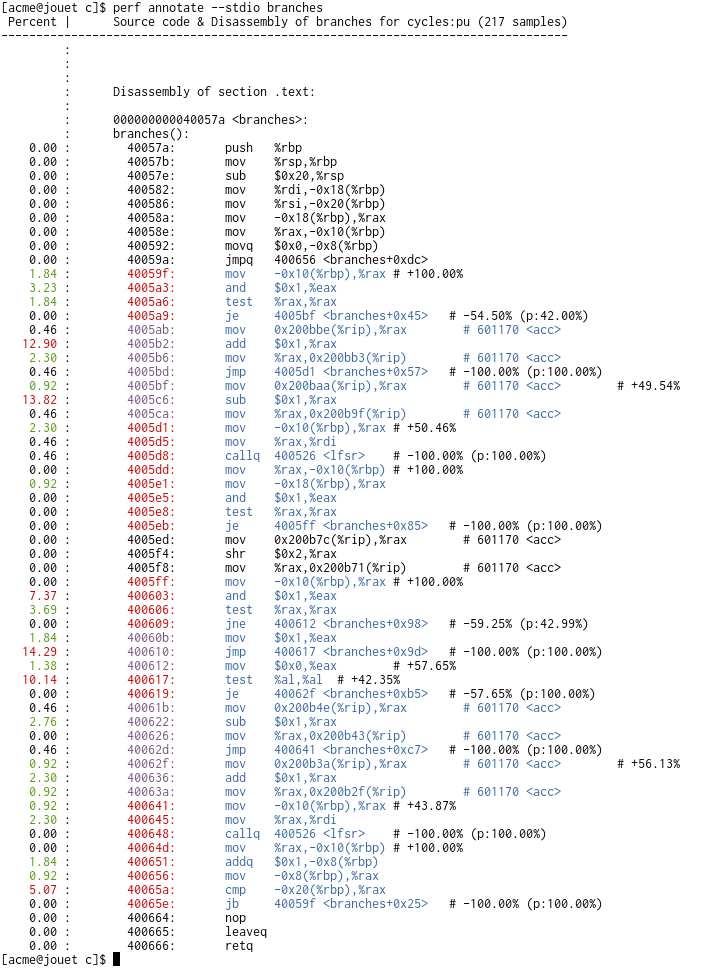
I wanted to know the hottest path through a function and figured the
branch-stack (LBR) information should be able to help out with that.

The below uses the branch-stack to create basic blocks and generate
statistics from them.

        from    to              branch_i
        * ----> *
                |
                | block
                v
                * ----> *
                from    to      branch_i+1

The blocks are broken down into non-overlapping ranges, while tracking
if the start of each range is an entry point and/or the end of a range
is a branch.

Each block iterates all ranges it covers (while splitting where required
to exactly match the block) and increments the 'coverage' count.

For the range including the branch we increment the taken counter, as
well as the pred counter if flags.predicted.

Using these number we can find if an instruction:

 - had coverage; given by:

        br->coverage / br->sym->max_coverage

   This metric ensures each symbol has a 100% spot, which reflects the
   observation that each symbol must have a most covered/hottest
   block.

 - is a branch target: br->is_target && br->start == add

 - for targets, how much of a branch's coverages comes from it:

	target->entry / branch->coverage

 - is a branch: br->is_branch && br->end == addr

 - for branches, how often it was taken:

        br->taken / br->coverage

   after all, all execution that didn't take the branch would have
   incremented the coverage and continued onward to a later branch.

 - for branches, how often it was predicted:

        br->pred / br->taken

The coverage percentage is used to color the address and asm sections;
for low (<1%) coverage we use NORMAL (uncolored), indicating that these
instructions are not 'important'. For high coverage (>75%) we color the
address RED.

For each branch, we add an asm comment after the instruction with
information on how often it was taken and predicted.

Output looks like (sans color, which does loose a lot of the
information :/)

$ perf record --branch-filter u,any -e cycles:p ./branches 27
$ perf annotate branches

 Percent |	Source code & Disassembly of branches for cycles:pu (217 samples)
---------------------------------------------------------------------------------
         :	branches():
    0.00 :	  40057a:       push   %rbp
    0.00 :	  40057b:       mov    %rsp,%rbp
    0.00 :	  40057e:       sub    $0x20,%rsp
    0.00 :	  400582:       mov    %rdi,-0x18(%rbp)
    0.00 :	  400586:       mov    %rsi,-0x20(%rbp)
    0.00 :	  40058a:       mov    -0x18(%rbp),%rax
    0.00 :	  40058e:       mov    %rax,-0x10(%rbp)
    0.00 :	  400592:       movq   $0x0,-0x8(%rbp)
    0.00 :	  40059a:       jmpq   400656 <branches+0xdc>
    1.84 :	  40059f:       mov    -0x10(%rbp),%rax	# +100.00%
    3.23 :	  4005a3:       and    $0x1,%eax
    1.84 :	  4005a6:       test   %rax,%rax
    0.00 :	  4005a9:       je     4005bf <branches+0x45>	# -54.50% (p:42.00%)
    0.46 :	  4005ab:       mov    0x200bbe(%rip),%rax        # 601170 <acc>
   12.90 :	  4005b2:       add    $0x1,%rax
    2.30 :	  4005b6:       mov    %rax,0x200bb3(%rip)        # 601170 <acc>
    0.46 :	  4005bd:       jmp    4005d1 <branches+0x57>	# -100.00% (p:100.00%)
    0.92 :	  4005bf:       mov    0x200baa(%rip),%rax        # 601170 <acc>	# +49.54%
   13.82 :	  4005c6:       sub    $0x1,%rax
    0.46 :	  4005ca:       mov    %rax,0x200b9f(%rip)        # 601170 <acc>
    2.30 :	  4005d1:       mov    -0x10(%rbp),%rax	# +50.46%
    0.46 :	  4005d5:       mov    %rax,%rdi
    0.46 :	  4005d8:       callq  400526 <lfsr>	# -100.00% (p:100.00%)
    0.00 :	  4005dd:       mov    %rax,-0x10(%rbp)	# +100.00%
    0.92 :	  4005e1:       mov    -0x18(%rbp),%rax
    0.00 :	  4005e5:       and    $0x1,%eax
    0.00 :	  4005e8:       test   %rax,%rax
    0.00 :	  4005eb:       je     4005ff <branches+0x85>	# -100.00% (p:100.00%)
    0.00 :	  4005ed:       mov    0x200b7c(%rip),%rax        # 601170 <acc>
    0.00 :	  4005f4:       shr    $0x2,%rax
    0.00 :	  4005f8:       mov    %rax,0x200b71(%rip)        # 601170 <acc>
    0.00 :	  4005ff:       mov    -0x10(%rbp),%rax	# +100.00%
    7.37 :	  400603:       and    $0x1,%eax
    3.69 :	  400606:       test   %rax,%rax
    0.00 :	  400609:       jne    400612 <branches+0x98>	# -59.25% (p:42.99%)
    1.84 :	  40060b:       mov    $0x1,%eax
   14.29 :	  400610:       jmp    400617 <branches+0x9d>	# -100.00% (p:100.00%)
    1.38 :	  400612:       mov    $0x0,%eax	# +57.65%
   10.14 :	  400617:       test   %al,%al	# +42.35%
    0.00 :	  400619:       je     40062f <branches+0xb5>	# -57.65% (p:100.00%)
    0.46 :	  40061b:       mov    0x200b4e(%rip),%rax        # 601170 <acc>
    2.76 :	  400622:       sub    $0x1,%rax
    0.00 :	  400626:       mov    %rax,0x200b43(%rip)        # 601170 <acc>
    0.46 :	  40062d:       jmp    400641 <branches+0xc7>	# -100.00% (p:100.00%)
    0.92 :	  40062f:       mov    0x200b3a(%rip),%rax        # 601170 <acc>	# +56.13%
    2.30 :	  400636:       add    $0x1,%rax
    0.92 :	  40063a:       mov    %rax,0x200b2f(%rip)        # 601170 <acc>
    0.92 :	  400641:       mov    -0x10(%rbp),%rax	# +43.87%
    2.30 :	  400645:       mov    %rax,%rdi
    0.00 :	  400648:       callq  400526 <lfsr>	# -100.00% (p:100.00%)
    0.00 :	  40064d:       mov    %rax,-0x10(%rbp)	# +100.00%
    1.84 :	  400651:       addq   $0x1,-0x8(%rbp)
    0.92 :	  400656:       mov    -0x8(%rbp),%rax
    5.07 :	  40065a:       cmp    -0x20(%rbp),%rax
    0.00 :	  40065e:       jb     40059f <branches+0x25>	# -100.00% (p:100.00%)
    0.00 :	  400664:       nop
    0.00 :	  400665:       leaveq
    0.00 :	  400666:       retq

(Note: the --branch-filter u,any was used to avoid spurious target and
branch points due to interrupts/faults, they show up as very small -/+
annotations on 'weird' locations)

Committer note:

Please take a look at:

  http://vger.kernel.org/~acme/perf/annotate_basic_blocks.png

To see the colors.

Signed-off-by: Peter Zijlstra (Intel) <[email protected]>
Tested-by: Arnaldo Carvalho de Melo <[email protected]>
Cc: Alexander Shishkin <[email protected]>
Cc: Andi Kleen <[email protected]>
Cc: Anshuman Khandual <[email protected]>
Cc: David Carrillo-Cisneros <[email protected]>
Cc: Jiri Olsa <[email protected]>
Cc: Kan Liang <[email protected]>
Cc: Linus Torvalds <[email protected]>
Cc: Namhyung Kim <[email protected]>
Cc: Stephane Eranian <[email protected]>
[ Moved sym->max_coverage to 'struct annotate', aka symbol__annotate(sym) ]
Signed-off-by: Arnaldo Carvalho de Melo <[email protected]>
The current percpu-rwsem read side is entirely free of serializing insns
at the cost of having a synchronize_sched() in the write path.

The latency of the synchronize_sched() is too high for cgroups. The
commit 1ed1328792 talks about the write path being a fairly cold path
but this is not the case for Android which moves task to the foreground
cgroup and back around binder IPC calls from foreground processes to
background processes, so it is significantly hotter than human initiated
operations.

Switch cgroup_threadgroup_rwsem into the slow mode for now to avoid the
problem, hopefully it should not be that slow after another commit:

  80127a3968 ("locking/percpu-rwsem: Optimize readers and reduce global impact").

We could just add rcu_sync_enter() into cgroup_init() but we do not want
another synchronize_sched() at boot time, so this patch adds the new helper
which doesn't block but currently can only be called before the first use.

Reported-by: John Stultz <[email protected]>
Reported-by: Dmitry Shmidt <[email protected]>
Signed-off-by: Peter Zijlstra (Intel) <[email protected]>
Signed-off-by: Oleg Nesterov <[email protected]>
Signed-off-by: Peter Zijlstra (Intel) <[email protected]>
Cc: Andrew Morton <[email protected]>
Cc: Colin Cross <[email protected]>
Cc: Linus Torvalds <[email protected]>
Cc: Paul E. McKenney <[email protected]>
Cc: Peter Zijlstra <[email protected]>
Cc: Rom Lemarchand <[email protected]>
Cc: Tejun Heo <[email protected]>
Cc: Thomas Gleixner <[email protected]>
Cc: Todd Kjos <[email protected]>
Link: http://lkml.kernel.org/r/[email protected]
Signed-off-by: Ingo Molnar <[email protected]>
Mike reports:

 Roughly 10% of the time, ltp testcase getrusage04 fails:
 getrusage04    0  TINFO  :  Expected timers granularity is 4000 us
 getrusage04    0  TINFO  :  Using 1 as multiply factor for max [us]time increment (1000+4000us)!
 getrusage04    0  TINFO  :  utime:           0us; stime:         179us
 getrusage04    0  TINFO  :  utime:        3751us; stime:           0us
 getrusage04    1  TFAIL  :  getrusage04.c:133: stime increased > 5000us:

And tracked it down to the case where the task simply doesn't get
_any_ [us]time ticks.

Update the code to assume all rtime is utime when we lack information,
thus ensuring a task that elides the tick gets time accounted.

Reported-by: Mike Galbraith <[email protected]>
Tested-by: Mike Galbraith <[email protected]>
Signed-off-by: Peter Zijlstra (Intel) <[email protected]>
Cc: Frederic Weisbecker <[email protected]>
Cc: Fredrik Markstrom <[email protected]>
Cc: Linus Torvalds <[email protected]>
Cc: Paolo Bonzini <[email protected]>
Cc: Peter Zijlstra <[email protected]>
Cc: Radim <[email protected]>
Cc: Rik van Riel <[email protected]>
Cc: Stephane Eranian <[email protected]>
Cc: Thomas Gleixner <[email protected]>
Cc: Vince Weaver <[email protected]>
Cc: Wanpeng Li <[email protected]>
Cc: [email protected] # 4.3+
Fixes: 9d7fb04276 ("sched/cputime: Guarantee stime + utime == rtime")
Signed-off-by: Ingo Molnar <[email protected]>
Vincent reported triggering the WARN_ON_ONCE() in event_function_local().

While thinking through cases I noticed that by using event_function()
directly, we miss the inactive case usually handled by
event_function_call().

Therefore construct a blend of event_function_call() and
event_function() that handles the cases relevant to
event_function_local().

Reported-by: Vince Weaver <[email protected]>
Signed-off-by: Peter Zijlstra (Intel) <[email protected]>
Cc: Alexander Shishkin <[email protected]>
Cc: Arnaldo Carvalho de Melo <[email protected]>
Cc: Jiri Olsa <[email protected]>
Cc: Linus Torvalds <[email protected]>
Cc: Peter Zijlstra <[email protected]>
Cc: Stephane Eranian <[email protected]>
Cc: Thomas Gleixner <[email protected]>
Cc: [email protected] # 4.5+
Fixes: fae3fde651 ("perf: Collapse and fix event_function_call() users")
Signed-off-by: Ingo Molnar <[email protected]>
Currently the percpu-rwsem switches to (global) atomic ops while a
writer is waiting; which could be quite a while and slows down
releasing the readers.

This patch cures this problem by ordering the reader-state vs
reader-count (see the comments in __percpu_down_read() and
percpu_down_write()). This changes a global atomic op into a full
memory barrier, which doesn't have the global cacheline contention.

This also enables using the percpu-rwsem with rcu_sync disabled in order
to bias the implementation differently, reducing the writer latency by
adding some cost to readers.

Signed-off-by: Peter Zijlstra (Intel) <[email protected]>
Reviewed-by: Oleg Nesterov <[email protected]>
Cc: Andrew Morton <[email protected]>
Cc: Linus Torvalds <[email protected]>
Cc: Paul E. McKenney <[email protected]>
Cc: Paul McKenney <[email protected]>
Cc: Peter Zijlstra <[email protected]>
Cc: Thomas Gleixner <[email protected]>
Cc: [email protected]
[ Fixed modular build. ]
Signed-off-by: Ingo Molnar <[email protected]>
Vincent noted that the update_tg_load_avg() usage in commit:

  3d30544f02 ("sched/fair: Apply more PELT fixes")

isn't entirely sufficient. We need to call this function every time
cfs_rq->avg.load changes, this includes when update_cfs_rq_load_avg()
returns true, but {attach,detach}_entity_load_avg() themselves also
change it. This means we need to unconditionally call
update_tg_load_avg().

Also, add more comments.

Reported-by: Vincent Guittot <[email protected]>
Signed-off-by: Peter Zijlstra (Intel) <[email protected]>
Cc: Linus Torvalds <[email protected]>
Cc: Mike Galbraith <[email protected]>
Cc: Peter Zijlstra <[email protected]>
Cc: Thomas Gleixner <[email protected]>
Cc: [email protected]
Signed-off-by: Ingo Molnar <[email protected]>
For perf record -b, which requires the pmu::sched_task callback the
current code is rather expensive:

     7.68%  sched-pipe  [kernel.vmlinux]    [k] perf_pmu_sched_task
     5.95%  sched-pipe  [kernel.vmlinux]    [k] __switch_to
     5.20%  sched-pipe  [kernel.vmlinux]    [k] __intel_pmu_disable_all
     3.95%  sched-pipe  perf                [.] worker_thread

The problem is that it will iterate all registered PMUs, most of which
will not have anything to do. Avoid this by keeping an explicit list
of PMUs that have requested the callback.

The perf_sched_cb_{inc,dec}() functions already takes the required pmu
argument, and now that these functions are no longer called from NMI
context we can use them to manage a list.

With this patch applied the function doesn't show up in the top 4
anymore (it dropped to 18th place).

     6.67%  sched-pipe  [kernel.vmlinux]    [k] __switch_to
     6.18%  sched-pipe  [kernel.vmlinux]    [k] __intel_pmu_disable_all
     3.92%  sched-pipe  [kernel.vmlinux]    [k] switch_mm_irqs_off
     3.71%  sched-pipe  perf                [.] worker_thread

Signed-off-by: Peter Zijlstra (Intel) <[email protected]>
Cc: Alexander Shishkin <[email protected]>
Cc: Arnaldo Carvalho de Melo <[email protected]>
Cc: Jiri Olsa <[email protected]>
Cc: Linus Torvalds <[email protected]>
Cc: Peter Zijlstra <[email protected]>
Cc: Stephane Eranian <[email protected]>
Cc: Thomas Gleixner <[email protected]>
Cc: Vince Weaver <[email protected]>
Cc: [email protected]
Signed-off-by: Ingo Molnar <[email protected]>
The lbr_context logic confused me; it appears to me to try and do the
same thing the pmu::sched_task() callback does now, but limited to
per-task events.

So rip it out. Afaict this should also improve performance, because I
think the current code can end up doing lbr_reset() twice, once from
the pmu::add() and then again from pmu::sched_task(), and MSR writes
(all 3*16 of them) are expensive!!

While thinking through the cases that need the reset it occured to me
the first install of an event in an active context needs to reset the
LBR (who knows what crap is in there), but detecting this case is
somewhat hard.

Signed-off-by: Peter Zijlstra (Intel) <[email protected]>
Cc: Alexander Shishkin <[email protected]>
Cc: Arnaldo Carvalho de Melo <[email protected]>
Cc: Jiri Olsa <[email protected]>
Cc: Linus Torvalds <[email protected]>
Cc: Peter Zijlstra <[email protected]>
Cc: Stephane Eranian <[email protected]>
Cc: Thomas Gleixner <[email protected]>
Cc: Vince Weaver <[email protected]>
Cc: [email protected]
Signed-off-by: Ingo Molnar <[email protected]>
Currently perf_sched_cb_{inc,dec}() are called from
pmu::{start,stop}(), which has the problem that this can happen from
NMI context, this is making it hard to optimize perf_pmu_sched_task().

Furthermore, we really only need this accounting on pmu::{add,del}(),
so doing it from pmu::{start,stop}() is doing more work than we really
need.

Introduce x86_pmu::{add,del}() and wire up the LBR and PEBS.

Signed-off-by: Peter Zijlstra (Intel) <[email protected]>
Cc: Alexander Shishkin <[email protected]>
Cc: Arnaldo Carvalho de Melo <[email protected]>
Cc: Jiri Olsa <[email protected]>
Cc: Linus Torvalds <[email protected]>
Cc: Peter Zijlstra <[email protected]>
Cc: Stephane Eranian <[email protected]>
Cc: Thomas Gleixner <[email protected]>
Cc: Vince Weaver <[email protected]>
Cc: [email protected]
Signed-off-by: Ingo Molnar <[email protected]>
In order to allow optimizing perf_pmu_sched_task() we must ensure
perf_sched_cb_{inc,dec}() are no longer called from NMI context; this
means that pmu::{start,stop}() can no longer use them.

Prepare for this by reworking the whole large PEBS setup code.

The current code relied on the cpuc->pebs_enabled state, however since
that reflects the current active state as per pmu::{start,stop}() we
can no longer rely on this.

Introduce two counters: cpuc->n_pebs and cpuc->n_large_pebs which
count the total number of PEBS events and the number of PEBS events
that have FREERUNNING set, resp.. With this we can tell if the current
setup requires a single record interrupt threshold or can use a larger
buffer.

This also improves the code in that it re-enables the large threshold
once the PEBS event that required single record gets removed.

Signed-off-by: Peter Zijlstra (Intel) <[email protected]>
Cc: Alexander Shishkin <[email protected]>
Cc: Arnaldo Carvalho de Melo <[email protected]>
Cc: Jiri Olsa <[email protected]>
Cc: Linus Torvalds <[email protected]>
Cc: Peter Zijlstra <[email protected]>
Cc: Stephane Eranian <[email protected]>
Cc: Thomas Gleixner <[email protected]>
Cc: Vince Weaver <[email protected]>
Cc: [email protected]
Signed-off-by: Ingo Molnar <[email protected]>
Vegard Nossum reported that perf fuzzing generates a NULL
pointer dereference crash:

> Digging a bit deeper into this, it seems the event itself is getting
> created by perf_event_open() and it gets added to the pmu_event_list
> through:
>
> perf_event_open()
>  - perf_event_alloc()
>     - account_event()
>        - account_pmu_sb_event()
>           - attach_sb_event()
>
> so at this point the event is being attached but its ->ctx is still
> NULL. It seems like ->ctx is set just a bit later in
> perf_event_open(), though.
>
> But before that, __schedule() comes along and creates a stack trace
> similar to the one above:
>
> __schedule()
>  - __perf_event_task_sched_out()
>    - perf_iterate_sb()
>      - perf_iterate_sb_cpu()
>         - event_filter_match()
>           - perf_cgroup_match()
>             - __get_cpu_context()
>               - (dereference ctx which is NULL)
>
> So I guess the question is... should the event be attached (= put on
> the list) before ->ctx gets set? Or should the cgroup code check for a
> NULL ->ctx?

The latter seems like the simplest solution. Moving the list-add later
creates a bit of a mess.

Reported-by: Vegard Nossum <[email protected]>
Tested-by: Vegard Nossum <[email protected]>
Tested-by: Vince Weaver <[email protected]>
Signed-off-by: Peter Zijlstra (Intel) <[email protected]>
Cc: Alexander Shishkin <[email protected]>
Cc: Arnaldo Carvalho de Melo <[email protected]>
Cc: David Carrillo-Cisneros <[email protected]>
Cc: Jiri Olsa <[email protected]>
Cc: Kan Liang <[email protected]>
Cc: Linus Torvalds <[email protected]>
Cc: Peter Zijlstra <[email protected]>
Cc: Stephane Eranian <[email protected]>
Cc: Thomas Gleixner <[email protected]>
Fixes: f2fb6bef92 ("perf/core: Optimize side-band event delivery")
Link: http://lkml.kernel.org/r/[email protected]
Signed-off-by: Ingo Molnar <[email protected]>
 Peter Zijlstra